Does Microsoft Word Autosave On Mac
Posted : admin On 10.04.2020- Word Autosave On Mac
- Does Microsoft Word Autosave On Mac Download
- Microsoft Excel Autosave
- Autosave In Word For Mac
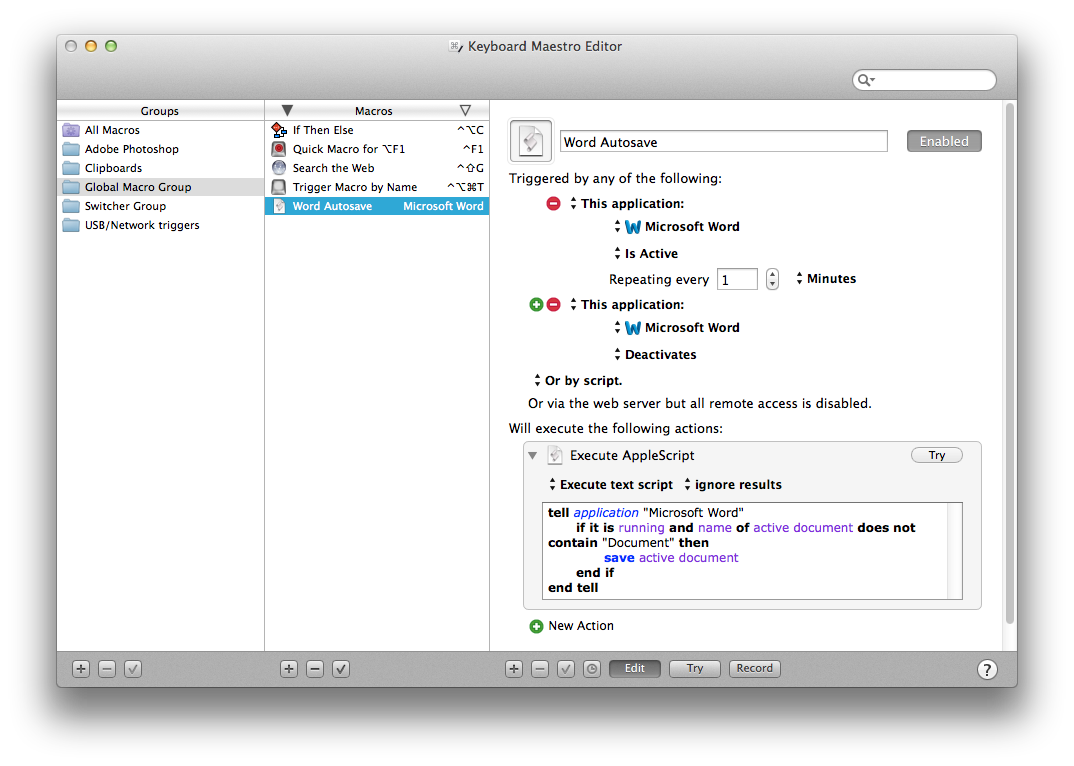
AutoSave is a different feature which automatically saves your file as you work - just like if you save the file manually - so that you don't have to worry about saving on the go. On the Mac, AutoSave is available in Excel, Word, and PowerPoint for Office 365 for Mac subscribers. When AutoSave is turned on AutoRecover files are rarely needed.
I have Microsoft 2008 Word for Mac. I worked on a document the other day for 4 hours when Word froze. I had to force quit and lost all of my work (I know, I should have been saving all along but I forgot this time!). Does anyone know if Word has an autosave feature. Learn about how AutoSave works in Excel, PowerPoint, and Word, and how it can impact add-ins or macros. Overview of AutoSave When a file is hosted in the cloud (that is, OneDrive, OneDrive for Business, or SharePoint Online), AutoSave enables the user's edits to be saved automatically and continuously.
Summary
In this article, you will learn 4 effective ways to recover unsaved, lost and deleted Word document on Mac with detailed steps: [1]recover with AutoRecovery; [2]Recover from Temp folder; [3]Recover from Recovered item in Trash; [4]recover with Word file recovery software.
Accidentally closed Word without saving on Mac? Do you know how to recover unsaved Word documents on Mac? According to the unique features of Microsoft Word for Mac, you may find the unsaved item in the AutoRecovery folder, Temporary folder or Recovered item in Trash. Besides, if you unintentionally lost, deleted or formatted your Word document, you can recover a Word document on Mac with EaseUS Word file recovery software.
| Workable Solutions | Step-by-step Troubleshooting |
|---|---|
| Recover Unsaved Word Document | #1. Recover from the AutoRecovery folder..Full steps |
| Recover Deleted Word Document | #4. Recover with Word file recovery software..Full steps |
How to Recover Unsaved Word Document on Mac
Embedded with more useful features in certain collaborative situations than Pages, Microsoft Word becomes increasingly popular among Mac computers. Office 365 even allows users to create Word files on their Mac. On one hand, Microsoft Word offers standard DOC or DOCX file formats that are compatible in almost every OS platform; On the other hand, Word 2020, 2019, 2018..2011 is featured with auto-saving, which enables us to recover a Word document before we could hit Save.
Based on the features of Microsoft Word for Mac, there are three potential ways to recover your unsaved Word documents. These methods can also be applied to recover unsaved Excel files on your Mac.
#1. Recover Unsaved Word Docs on Mac with AutoRecovery
The Word for Mac includes an AutoRecovery option. It is turned on by default. The app will automatically save a copy of an open Word file every 10 minutes. If Word freezes while you're working on a document, or if the computer crashes, you can use the AutoRecovery copy to recover unsaved Word document with the changes or additions that you made in your last Word for Mac session.
Guide: How to recover an unsaved Word document
Unlike recovering unsaved Word document in Windows, the file recovery on Mac from the AutoRecovery folder is different.
Step 1. Open 'Finder' on your Mac, then head to 'Go' > 'Go to Folder'.
Step 2. Type: ~/Library/Containers/com.microsoft.Word/Data/Library/Preferences/AutoRecovery and click 'Go'.
Step 3. Open the AutoRecovery folder, locate all the files that start with the words 'AutoRecovery save of'. Select the one you want to recover, rename the file, then add the '.doc' filename extension.
Step 4. Double-click the file. The document now opens in Word for Mac.
Free microsoft for mac downloads. Step 5. Click the File menu and select 'Save As'. Type a new name for the file into the Name field, select a folder for the file and click the 'Save' button.
#2. Recover Unsaved Word Documents on Mac from TMP Folder
The Word for Mac saves a copy of the unsaved document named as Word Work File in the Temporary folder. Your Mac also temporarily keep files in this folder. Though for many Mac users, it's not easy to find it.
Guide: How to recover an unsaved Word document on Mac
Step 1. Go to 'Applications' > 'Utilities' and double-click 'Terminal'.
Step 2. In Terminal, enter open $TMPDIR and you will be directed to the TMP folder which is used to keep files temporarily.
Step 3. In the TMP folder, find and open the folder named 'TemporaryItems'. In it, right-click the desired unsaved Word files and 'Open with..' Microsoft Word.
Step 4. Save the Word file by clicking on 'File' > 'Save As' and save it to another location.
#3. Recover Unsaved Word Document on Mac from Recovered Item
The Word for Mac temporarily saves documents that the user has not yet saved themselves in a folder named 'Recovered items', located in the Trash. If there are no recovered files, this folder will not appear.
Guide: How to find unsaved Word files on Mac
Step 1. Open 'Trash' by clicking its icon on the dock.
Step 2. Look for a folder labeled 'Recovered items' and click into it to look for your unsaved Word file. If you cannot find it, try the next solution.
#4. Recover Deleted Word Document with Word Recovery Software
The aforementioned three ways are exclusively for saving the file you're currently working on but suddenly disappear before clicking the Save button. To be specific, the methods will only work for files that are in the process of being worked on when they disappeared. Hence, if you lost a Word doc that is already existed by deletion, disk formatting or losing its access, you need to turn to other ways to recover a Word document on Mac.
2011-1-30 Question: Q: Re-install MS office 2011 without disc? Hello, I bought my first Mac tonight: a used macbook pro. It is currently loaded with a fully functioning copy of office 2011 complete with valid produxt key. I would like to perform. A wipe/OS reinstall prior. Install microsoft office 2011 mac without discharge. For one-time purchases of Office for Mac 2011 you can install Office on only one computer. However, you may transfer Office for Mac 2011 to another computer that belongs to you if you experience a hardware failure or you buy a new computer. For more information. If you want to do a custom install or uninstall where you select only some apps, see the section below Install or remove individual Office programs or components. Install 32-bit (default) Office 2010. Insert the Office 2010 disc into the drive. If the setup wizard doesn’t start automatically, navigate to the disc drive and click SETUP.EXE. 2020-3-13 Tech support scams are an industry-wide issue where scammers trick you into paying for unnecessary technical support services. You can help protect yourself from scammers by verifying that the contact is a Microsoft Agent or Microsoft Employee and that the phone number is an official Microsoft global customer service number.
EaseUS Data Recovery Wizard for Mac is third-party specialized Mac data recovery software that can scour your hard drive, external hard drive, SD card, or USB flash drive to find all the lost data that vanishes without a trace on Mac OS X/macOS. It doesn't matter whether you emptied the trash bin or not, the deleted file will show up after you use the program to scan your selected drive.
For the first attempt, we strongly recommend you download its free version. It won't cost you a penny to search for your missing files. And since your problem is only for a few lost Word files, the 2GB recovery limit should be more than enough. The scan & recovery process is very simple, we’ll show you how it works.
Guide: How to recover a Word document on Mac
Step 1. Select the location where your important Word documents were lost and click Scan button.
Step 2. EaseUS Data Recovery Wizard for Mac will start immediately a quick scan as well as a deep scan on your selected disk volume. Meanwhile, the scanning results will be presented in the left pane.
Step 3. By Path and Type, you can quickly filter the Word files you've lost earlier. Select the target files and click Recover Now button to get them back at once.
How to Increase the Chance of Unsaved Word Data Recovery
After suffering from the fear of losing your Word documents, you must not want to experience this kind of situation again. Thus, it's necessary for you to know how to avoid losing your Word files. To avoid completely losing your files, you can:
Tip 1. Save the Word Document Whenever You Create a New One
An ever unsaved Word document exists in the computer's RAM, not on the hard disk. Thus, the chances to save a Word Document that has never been saved before are slim. Knowing this should give you a hint that you should save the word document at least once whenever you create a new one.
Tip 2. Change the AutoSave Interval
After you save your Word document, the AutoSave feature will begin to work. To minimize the loss of the progress on the file you are working, you can change the frequency of AutoSave:
Step 1. Open Microsoft Word on your Mac.
Step 2. Go to 'Word' > 'Preferences' and click 'Save' under Output and Sharing.
Step 3. Check all the items under Save Options (Recommended) and change the interval of AutoSave, for example, from every 10 minutes to every 5 minutes.
If you follow the two tips above, you will substantially decrease the risk of losing your Word documents. What if you carelessly deleted your important Word files on your Mac? No worry. Try the free method to retrieve permanently deleted Word documents with EaseUS Data Recovery Wizard for Mac.
-->Learn about how AutoSave works in Excel, PowerPoint, and Word, and how it can impact add-ins or macros.
Overview of AutoSave
When a file is hosted in the cloud (that is, OneDrive, OneDrive for Business, or SharePoint Online), AutoSave enables the user's edits to be saved automatically and continuously. When the file is shared with others, their changes are merged into this user's version of the file. If AutoSave is turned off, save must be triggered manually for the user's changes to be persisted in the cloud and for this user to receive others' changes.
Currently, Excel, Word, and PowerPoint provide a BeforeSave event that allows a developer to execute code after the user triggers a save but before the save occurs. Excel also provides an AfterSave event that can execute macro or add-in code after the save completes.
When AutoSave is enabled, these events fire automatically on a periodic basis without user interaction. Because of this, add-ins and macros that leverage these events may experience problems when AutoSave is on.
In general, these issues can be avoided if the user chooses to disable AutoSave. You can do this on the user’s behalf by using the AutoSaveOn property in Word, Excel, and PowerPoint if it's available (see the following example). You can also take steps as a developer to mitigate these problems so that your add-ins and macros work smoothly, even if AutoSave is enabled.
Example
This example turns off AutoSave and notifies the user that the workbook is not being automatically saved.
Potential issues with save events and AutoSave
Word Autosave On Mac
You may need to handle one or more of the following issues regarding the interaction between save events and AutoSave:
Issue 1: Code in BeforeSave or AfterSave events runs too long
In general, Word, Excel and PowerPoint are not responsive to user interaction while add-in or macro code is being run. Therefore, if your code in a BeforeSave or AfterSave event handler takes too long to run, it may significantly degrade the user experience.
When AutoSave is disabled, this code is only run when the user explicitly chooses to save, so a delay is not as noticeable and can be avoided by the user until he or she is ready to save.
When AutoSave is enabled, this code runs automatically on a periodic basis, which has the potential to interrupt the user, especially if the code takes a long time.
Example scenario
Imagine an add-in that allows the user to create custom maps based on data in an Excel workbook. Such an add-in might have BeforeSave code that serializes any maps that the user has created and stores them in the workbook in a CustomXML part. This process might take a second to complete, and Excel could be unresponsive while this is happening.
When AutoSave is off, the user gets to choose when he or she wants to save, and therefore, even though the add-in slows down the save process slightly, the user does not notice.
When AutoSave is enabled, this BeforeSave code runs automatically on a periodic basis even if the user is in the middle of something else (such as typing data into a cell), which could be extremely annoying.
Workaround
Add-ins should try to avoid long-running operations inside of a save event. In this example, the developer could choose to persist the custom maps to the file as they are created or modified by the user, rather than waiting for the save event.
Issue 2: Code in save events surfaces a modal dialog
Any code that runs in a save event that displays UI such as a modal dialog has the potential to seriously degrade the user experience when AutoSave is on. Because the BeforeSave and AfterSave events run automatically on a periodic basis, these dialog boxes may interrupt the user's normal workflow.
Example scenario
An add-in that validates a Word document before save to ensure that company branding is applied might fire a dialog box that alerts the user about any problems that were found and offers a way to correct them. Because the BeforeSave event now fires automatically and continuously, this validation dialog might appear suddenly while the user is doing something else.
Workarounds
Consider removing any code that needs to display UI to other areas of the application. For example, the user could select a 'validate' button to trigger the validation process, or you could fire the validation code only if the user attempts to change the existing data.
If you want validation code to trigger only on the first save from a new document but not on subsequent auto-saves, consider inspecting a property such as Excel's Workbook.Path before displaying any UI during BeforeSave or AfterSave. In Excel, the Workbook.Path property should be blank if the workbook does not yet have a save location.
Issue 3: Code in save events clears the undo stack (Excel only)
In general, if you run certain VBA statements in Excel, the undo stack will be cleared. For example, if you change the value of a cell by running ActiveCell.Value = 'myValue', the undo stack is cleared. If such code is present in the BeforeSave or AfterSave event for a macro or add-in, and AutoSave is on, a user of that macro or add-in will frequently not be able to undo normal user actions as expected.
Example scenario
An add-in might have code that runs in response to the BeforeSave event that inspects the document and writes values to a 'log' table in the workbook. When AutoSave is on, this would clear the undo stack periodically, which can potentially annoy users.
Workaround
Consider removing code that writes to the workbook in BeforeSave or AfterSave events. For example, the add-in described in the example scenario might be modified to store the change log in a separate file or database.
Issue 4: Code in AfterSave dirties the workbook (Excel only)
When AutoSave is on, the BeforeSave and AfterSave events will only trigger if there has been a change in the workbook since the last time they were triggered. If code in the AfterSave event dirties the workbook (that is, makes additional changes), that could potentially trigger events to fire again for the same change, and then queue up the events to fire again indefinitely. This could waste system resources and affect battery life.
Workaround
Code that dirties the workbook in AfterSave should be moved to BeforeSave or to another location entirely (see Issue 3). This isn't a good practice today, even without AutoSave, because it leaves the workbook in a perpetual 'dirty' state, which causes a prompt to appear on close that asks the user to save their changes even if they made no additional changes.
Issue 5: Code in BeforeSave cancels the file save (by setting Cancel argument to True)
Today, it is possible to cancel the save in the BeforeSave event by setting Cancel to True:
When AutoSave is enabled, the application (that is, Excel, Word, or PowerPoint) triggers saves automatically on a continuous basis until the file has no more unsaved changes. After the user makes a single change to the file, the application attempts to save it.
If the developer chooses to cancel the save in the manner described earlier, the application continually determines that there are unsaved changes, which causes the save to (eventually) be attempted again. Because the same event code that cancelled the first save will also cancel this second save attempt, the process will continue for as long as the file is open, potentially degrading performance and battery life.
Example scenario
An add-in might completely override the default Word save code so that the file is saved to a corporate database instead of to a disk or SharePoint location. Such an add-in would first cancel the attempted save before trying to save in another place.
Workaround
Such add-ins should ensure that AutoSave is turned off by setting AutoSaveOn to False. Because a file must already be saved in a OneDrive or SharePoint location for AutoSave to be on, AutoSave should already be off or disabled in most versions of this scenario.
Does Microsoft Word Autosave On Mac Download
See also
Microsoft Excel Autosave
Support and feedback
Autosave In Word For Mac
Have questions or feedback about Office VBA or this documentation? Please see Office VBA support and feedback for guidance about the ways you can receive support and provide feedback.