Microsoft Word For Mac 15 Default Header And Footer
Posted : admin On 10.04.2020- Microsoft Word For Mac 15 Default Header And Footers
- Microsoft Word For Mac 15 Default Header And Footer Page
- Amc 15
You can create headers and footers in Microsoft Word that repeat the same text at the top or bottom of each page. For example, if you’re typing the minutes of a club meeting, you may want to put the club’s name in the header so that it appears across the top of each page.
Note: I'm on Microsoft Word for Mac version 16.33. The steps may differ slightly depending on what version of Microsoft Word you're using. Work With Headers and Footers in MS Word. Adding a Microsoft Word header or footer is quite intuitive. Follow these steps: 1. How to Insert Headers and Footers. To add a header, go to Insert Header. The button is found on the far-right end of the Header & Footer Tools Design tab. To add a footer, choose the Footer button in Step 2 and think of the word footer whenever you see the word header in the preceding steps. After you exit from the header or footer, you can see its. To remove a footer, choose Footer→Remove Footer. 1 Go to the page where the header exists. Use Print Layout view (found on the View tab in the Document Views group) for this step so that you can see the ghostly image of the header (or footer). You may need to edit for better formatting. For more info, see Add page numbers to a header or footer in Word. To change the font, color or size Select the text to change then go to Home and choose the options you want from the Font section. To add an image to a header or footer See Add images to a header or footer.
Every document has a header and footer area, which are both empty by default. The header and footer appear in Print Layout view, Full Page Reading view, and Web Layout view, and also on the printed page. (If you are in Draft view, you may want to switch to Print Layout view to follow along in this section more easily.)
Here are two ways of putting content into headers and footers:
Manually: In Print Layout view, double-click in the header or footer of the page. (Choose View→Print Layout.) This puts you in the Header and Footer editing mode, where you can type text directly into those areas.
You can’t edit the body of the document while you’re in this mode. To resume working within the main part of the document, double-click the main document (anywhere below the header or above the footer).
Have Word help: Choose Insert→Header or Insert→Footer and then select a preformatted header or footer placeholder. This also places you in Header and Footer editing mode automatically, and you can edit the text in the placeholders that were inserted. Depending on the sample you pick, there may be not only a text placeholder but also a page-numbering code. This saves you the step of inserting the page-numbering code separately.
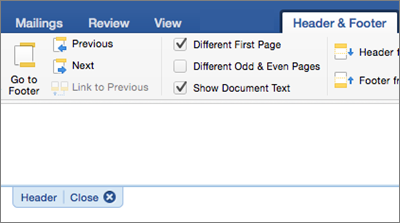
You can manually insert a page-numbering code into a header or footer as well as codes for the current date, time, and other information. When the insertion point is in the header or footer area, the Header & Footer Tools Design tab appears on the Ribbon. On that tab are buttons for inserting various types of codes like that.
In the check boxes in the Options group, you can specify that you want a different header and footer for the first page (for example, so you can have a cover page without header and footer text), or that you want separate headers and footers for odd and even pages (for example, for a double-sided booklet where the page numbers should always be on the outside edge).
In the Position group, you can control the amount of space allotted to the header and footer. By default, each is 1/2-inch tall. You can change these values in the Header from Top and Footer from Bottom list boxes.
When you’re done working with the header and footer, double-click the main body of the document, or click the Close Header and Footer button on the Design tab.
Related articles:
Microsoft Word For Mac 15 Default Header And Footers
Click the Insert tab on the Word 2007 Ribbon.
The Insert tab is the second tab from the left, located between the Home and Page Layout tabs.
In the Header & Footer group, choose Header→Edit Header.
When you edit the header, Word tosses you into a special mode. The header appears on the screen as part of the page in Print Layout view. A new tab appears with groups customized for creating and editing headers.
Use the Go to Header and Go to Footer command buttons to switch between the header and footer for editing.
The Go to Header and Go to Footer buttons are located in the Navigation group.
Use the Go to Header and Go to Footer command buttons to switch between the header and footer for editing.
The Go to Header and Go to Footer buttons are located in the Navigation group.
Edit the header.
Items in the header are edited just like anything else — you can add, edit, or format text by using any of Word’s text- and paragraph-formatting options.
Use the command buttons on the Design tab’s Insert group for special items.
Choose from Page Number, Date & Time, Picture, Clip Art, and Quick Parts.
Microsoft Word For Mac 15 Default Header And Footer Page
Click the Close Header and Footer command button in the Close group on the far right side of the Ribbon.
Amc 15
You return to your document.
Microsoft Outlook Plugin for Mac. The RingCentral Meetings Plug-in for Microsoft Outlook provides seamless integration with Microsoft Outlook on Mac. It allows Users to to schedule an online meeting within Outlook and it automatically syncs with the RingCentral Meetings server. Users can also start an online meeting by clicking the RingCentral. Install the Zoom Microsoft Outlook Plugin from Zoom; 64-bit PC or Mac (the Outlook plugin is an 64-bit application; if you're using a 32-bit system, consider using the Office 365 Add-In).macOS 10.15 Catalina does not support plug-ins, including the Microsoft Outlook Plugin for Zoom. Downloading the plugin. 2020-2-29 The Zoom plugin is also responsible for Outlook crashing when you try to take it into Full Screen Mode (via window's green button). Per a chat with Microsoft Support: ```We have investigated on this and found it to be an issue on Zoom's end. Zoom offers two variations of an Outlook integration; the Zoom Plugin and Zoom Add-In. Both of these integrations allow customers to add a Zoom meeting to their Outlook calendar event. The Plugin is an application installation and the Add-In is a native integration in Microsoft Office AppSource. Zoom microsoft outlook plugin for mac pro.